
Part 4 - Cursor vs Claude Code: two doors into the same future, one feels like a studio, the other feels like a cockpit
When AI coding tools stop being assistants and start being infrastructure, the question isn't which one is better—it's which one matches how your brain wants to work

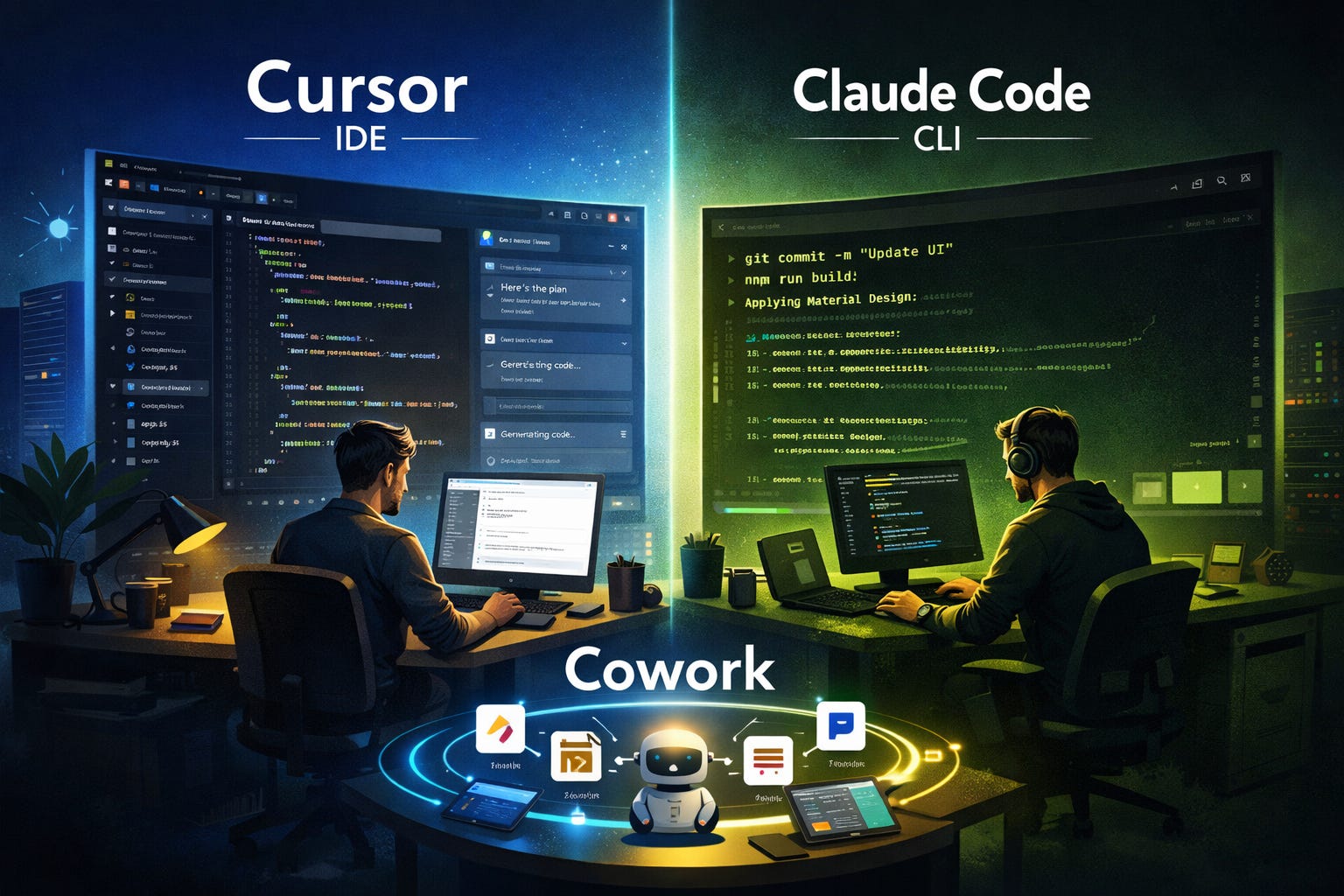
Cursor feels like a place you live, Claude Code feels like a place you drive.
Once you’ve felt both in your hands you stop arguing about which one is “better” and you start asking a more honest question: which one gives me leverage at this specific moment in the build, with this specific amount of context in my head, with this specific kind of work in front of me.
Cursor is an AI editor that inherits the muscle memory of a modern IDE, which means you get tabs, files, diffs, search, and the whole “I am inside the codebase” feeling, plus AI features like its Tab autocomplete and its Agent mode where you delegate tasks from inside the editor and it writes code while you keep steering.
Claude Code, in contrast, is explicitly designed to live in the terminal, which is a big deal because the terminal is still where real work quietly happens: navigating directories, grepping across a codebase, running scripts, executing tests, handling git workflows, and moving fast with the keyboard when your brain is already in flow.
Both can “help you code,” but that phrasing is already too small, because what they’re actually doing is collapsing the distance between intent and artifact, and they do it through two very different interfaces that shape how you think.
1) Cursor feels like an IDE, Claude Code feels like a CLI, and that matters more than people admit
For heavy code editing work, Cursor feels like home because it is literally structured as a full editor workflow, where you can see everything, refactor across files, review diffs, and keep your bearings while you iterate.
It’s also easier for non engineers to adopt because the interaction pattern is familiar: describe the goal, paste a plan, ask the agent to implement, and you can visually inspect what changed without having to love the terminal.
Claude Code is a different flavor of comfort: it’s the comfort of speed and tight workflow integration. The tool can read and manipulate your codebase, run commands, and do real developer chores like git actions through natural language, but in the environment engineers already treat as the source of truth.
If you grew up in the terminal, the CLI interface does not feel primitive, it feels like a power tool, because you can chain commands, pipe outputs, compose workflows, and stay on the keyboard.
2) The power difference comes from architecture, not features
I asked Claude Code to build a feature using Material Design principles. Halfway through, I realized the layout was wrong and told it to revise the plan. It did. It regenerated the structure, kept the context, and executed the new approach without me touching a file.
That’s not autocomplete. That’s not “chat next to an editor.” That’s an agent that can propose a plan, revise the plan when you apply taste, and turn your judgment into a sequence of executable steps.
Claude Code is built around an agentic model where you can give short commands, ask it to inspect the repo, make a plan, execute steps, and iterate in a loop that feels closer to working with a pair programmer who can actually touch the environment. Anthropic’s own guidance leans into this framing, because they talk about using it to build features from descriptions, debug issues, and operate against a codebase end to end.
The CLI also makes it feel fast, because latency feels different when you are not context switching between windows, you’re just issuing commands and watching work happen in the same surface where your build already lives.
3) Cowork made me realize Anthropic is building a work operating system, not just a developer tool
When I installed Cowork, I didn’t think “cool new feature.” I thought “oh, they’re building the enterprise layer.”
Cowork is the same agentic architecture as Claude Code, but surfaced in a way that looks like collaboration software instead of a terminal tool. It can access folders on your machine, execute multi step work, and maintain state across sessions. That last part is critical: it is not just chat, it is task execution with progress, history, and the ability to come back to finished work.
That’s exactly how enterprise software wins, because enterprises pay for reliability, repeatability, and workflow integration, not for vibes.
The connector story makes this even clearer. Linking to tools like Asana, Notion, and PayPal, plus broader “plugins” that organizations can tailor to job functions, is how you go from “AI assistant” to “AI coworker that actually fits how your company works.”
The Google Enterprise parallel is the right mental model. The big winners here will not be the ones with one killer feature, they will be the ones who own the surface area of work: the permissioning, the connectors, the default workflows, and the “safe enough to deploy at scale” story. Google made productivity suites sticky by being everywhere your work already lived.
Cowork comes with real risks, including accidental file operations when instructions are vague and prompt injection against tools. I appreciate that Anthropic and reviewers are not pretending those risks do not exist, because enterprise adoption is not just about capability, it’s about guardrails.
4) My actual workflow looks like a relay race between the two, because limits are real and specialization is rational
Tool choice is capacity planning in disguise. Usage caps and subscription limits shape behavior as much as product design does, and you can be “in love” with a tool and still bounce out of it when you hit limits.
In practice, Cursor is incredible for the first hour of a project, where you want to paste a full plan, generate a skeleton, create directories, wire the basic routes, and get something running fast enough that your brain believes the project is real.
Then Claude Code becomes the finisher, especially for the “make it actually good” phase: tighten UI behavior, clean up the structure, refactor with discipline, and do the kind of surgical iteration where a terminal agent that can move quickly through the repo feels like a cheat code.
When you’re deploying, the workflow becomes even more about operational speed: git actions, quick fixes, tight feedback loops, and that moment where you just want to ship the thing and stop thinking about it. Tools that are comfortable with version control and command execution feel disproportionately useful here.
5) The moment the economics became legible
I built a Calendly substitute in three hours because I needed a weird personal and professional calendar fusion with my own opinionated rules. The cost of customizing the off the shelf product became higher than building my own, and AI tools made that tradeoff flip.
Once you’ve built one working app in two or three hours, not a toy but a real thing you can deploy and use, something rewires in your brain. You realize that a meaningful chunk of SaaS was never “hard,” it was just time consuming, and the time cost is what created the market.
That is the deeper story here: the world is moving from buying software to building software, not for everything, not for mission critical systems overnight, but for a huge amount of personal workflow glue and departmental tooling that used to die in backlog purgatory because nobody had the time.
6) The new bottleneck is judgment
The frustrating truth is that usage limits turn into context switching, and context switching is the tax that kills flow, because going back and forth between tools interrupts the narrative you have in your head about what the product is supposed to become.
But the other truth is more personal: once you experience the feeling of constant creation, you start accumulating a backlog of ideas faster than you can possibly build them. Building stops being a scarce skill and becomes an available impulse.
I’ve built a chess app, a fine tuning studio, a debate app between two models, a scheduler, a vacation planner beta, and a bot that fights for hard reservations in New York City. Not because I needed all of them, but because I could.
The real question becomes not “can I build,” but “what deserves to exist.”
Your constraint is no longer execution, it is judgment.
That is quietly the most important leadership lesson in this whole wave. What does work look like when everyone on your team has this leverage? What decisions are you making differently? Are you saying no more? Building more throwaway prototypes? The tension between “I can build this” and “should I build this” is where the real work lives now.
The take that will age well
Cursor is the best on ramp for building quickly inside an IDE shaped world. Claude Code is the fastest way to operate against a codebase with terminal native speed. Cowork is Anthropic saying they want to own the enterprise workflow layer, not just the developer tool layer.
If you’re reading this with a slightly unsettled feeling, like you can’t go back to “normal” work now that you’ve tasted this leverage, welcome. That’s the point. The leverage is real, and it’s going to keep getting weirder.
Love the analogy — Cursor as 'studio' (lived-in feel) vs Claude Code as 'cockpit' (drive fast). Switched to Cursor for UI tweaks but Claude for deep refactors. Anyone else using both in combo? This series is fire!
I reckon the cockpit feel goes deeper than interface choice. The guy who built it, Boris Cherny, spent years on type inference at Meta and wrote the O'Reilly TypeScript book. The terminal wasn't an aesthetic call. It was a bet that reasoning quality matters more than visual integration. Covered his background here: https://reading.sh/who-is-boris-cherny-the-engineer-behind-claude-code-c2d9c6753f29?sk=139c376109a3af3db5110a3767d009c6